Component 3: Serious Games
Learning About Children's Rights Through Play and Cooperation
Component Overview
The Educational Games component offers engaging activities that enable pupils to consolidate their understanding of children's rights and European values.
Through collaborative games, pupils are encouraged to apply their knowledge, cooperate with one another, and solve challenges related to fundamental rights.
These activities promote active participation and strengthen learning in a dynamic and interactive environment.
Card Game: The Little Guardians of Rights
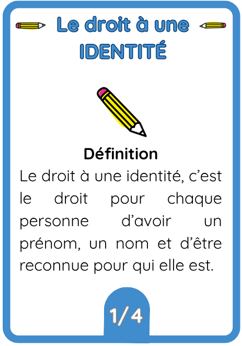
This educational card game enables pupils to discover children's rights through a fun and collaborative activity.
Players work to complete sets of cards representing different children's rights by matching four elements: definition, value, person, and situation.
The game promotes memorisation, cooperation and a deeper understanding of children's rights.
Practical information :
- Number of players: 2–6
- Level: Cycle 3 (ages 9–11)
- Objective: Complete as many full sets of cards as possible.
Download the game rules (PDF, 134 KB, in French)
Download the printable cards (PDF, 4.73 MB, in French)
Download the game box template (PDF, 204 KB, in French)
Escape Game: The Little European Explorers
The educational escape game enables pupils to explore children's rights through an immersive and collaborative learning experience.
Working in teams, pupils solve a series of puzzles related to European values, the European Union and fundamental rights.
This activity encourages cooperation, critical thinking and the application of knowledge in a fun and engaging context.
Activity organisation
- Designed for a class of 20 to 30 pupils
- Pupils work in groups of 4 to 6
- Each group solves the same set of puzzles
- Solutions may vary depending on the strategies adopted by each group
Download the escape game and its user guide (PDF, 7.83 MB, in French)
![[Translate to English:] Cofinancé par l'Union Européenne](/fileadmin/_processed_/5/a/csm_FR_Cofinance_par_l_Union_europeenne_POS_9db0ddc32b.jpg)
Funded by the European Union. Views and opinions expressed are however those of the author(s) only and do not necessarily reflect those of the European Union or the European Education and Culture Executive Agency (EACEA). Neither the European Union nor EACEA can be held responsible for them.